University of Minnesota-Twin Cities
STAT 4102
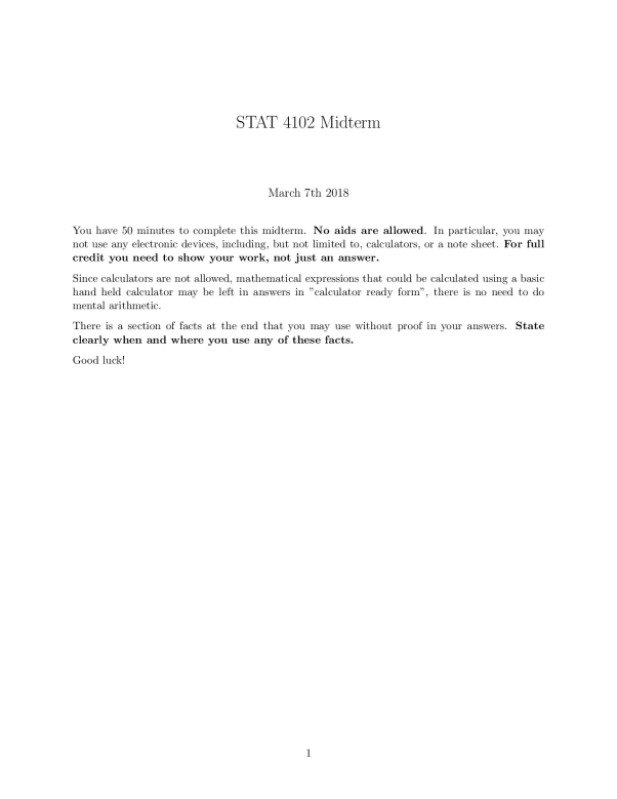
STAT 4102 Midterm March 7th 2018 You have 50 minutes to complete this midterm. No aids are allowed. In particular, you may not use any electronic devices, including, but not limited to, calculators, or a note sheet. For full credit you need to show your work, not just an answer. Since calculators are not allowed, mathematical expr
...[Show More]
STAT 4102 Midterm March 7th 2018 You have 50 minutes to complete this midterm. No aids are allowed. In particular, you may not use any electronic devices, including, but not limited to, calculators, or a note sheet. For full credit you need to show your work, not just an answer. Since calculators are not allowed, mathematical expressions that could be calculated using a basic hand held calculator may be left in answers in ”calculator ready form”, there is no need to do mental arithmetic. There is a section of facts at the end that you may use without proof in your answers. State clearly when and where you use any of these facts. Good luck! 1 Problems 1. Let Y be a random variable with mean θ and variance σ 2 , and define W = (Y − θ)/σ. (a) What is the mean and variance of W? If you make any additional assumptions, state them clearly. (b) Which, if any, of Y and W are statistics? Explain. 2. Suppose that Y1 ∼ N(µ1, σ2 1 ) and Y2 ∼ N(µ2, σ2 2 ). Suppose also that Y1 and Y2 are independent. (a) Derive the distribution of Z = [(Y1 − µ1)/σ1 + (Y2 − µ2)/σ2] 2/2. (b) Suppose that µ1 = µ1 = µ and σ1 = σ2 = 1, so µ is the only unknown constant and Z = [Y1 −µ+Y2 −µ] 2/2. Explain how to use this and the result in (a) to create a (1−α) % confidence interval for µ. Hint: You don’t need to construct the interval, only explain how it can be done using the results in (a) and (b). 3. Let Y1, . . . , Y11 be i.i.d. random variables with mean µ and variance σ 2 , both unknown. (a) Suppose we observe the sample mean ¯y = 20 and sample variance s 2 = 100. Create an 80% approximate confidence interval for µ, using the central limit theorem. Note: The interval should be two-sided and expressed in numbers only, e.g. [100, 200] and 75 ± 2 × √ 2.5 would both be valid answers. Hint: Consider a confidence interval in the general form ˆθ±aσˆθˆ, where a is some constant you have to pick, ˆσθˆ is an estimator of the standard deviation of the estimator ˆθ, and θ is the parameter of interest. Keep question (b) in mind. (b) What approximations did you have to use to c
[Show Less]